Microsoft 365 E7 Just Entered Your Renewal Conversation. Run the FinOps Math Before Procurement Says Yes.
Microsoft announced Microsoft 365 E7 on March 9, 2026. General availability starts May 1. Microsoft 365 E5 pricing changes on July 1. That creates a narrow renewal window where bad timing can make an AI bundle look cheaper, or more expensive, than it really is.
Freshness & Review
Review due soon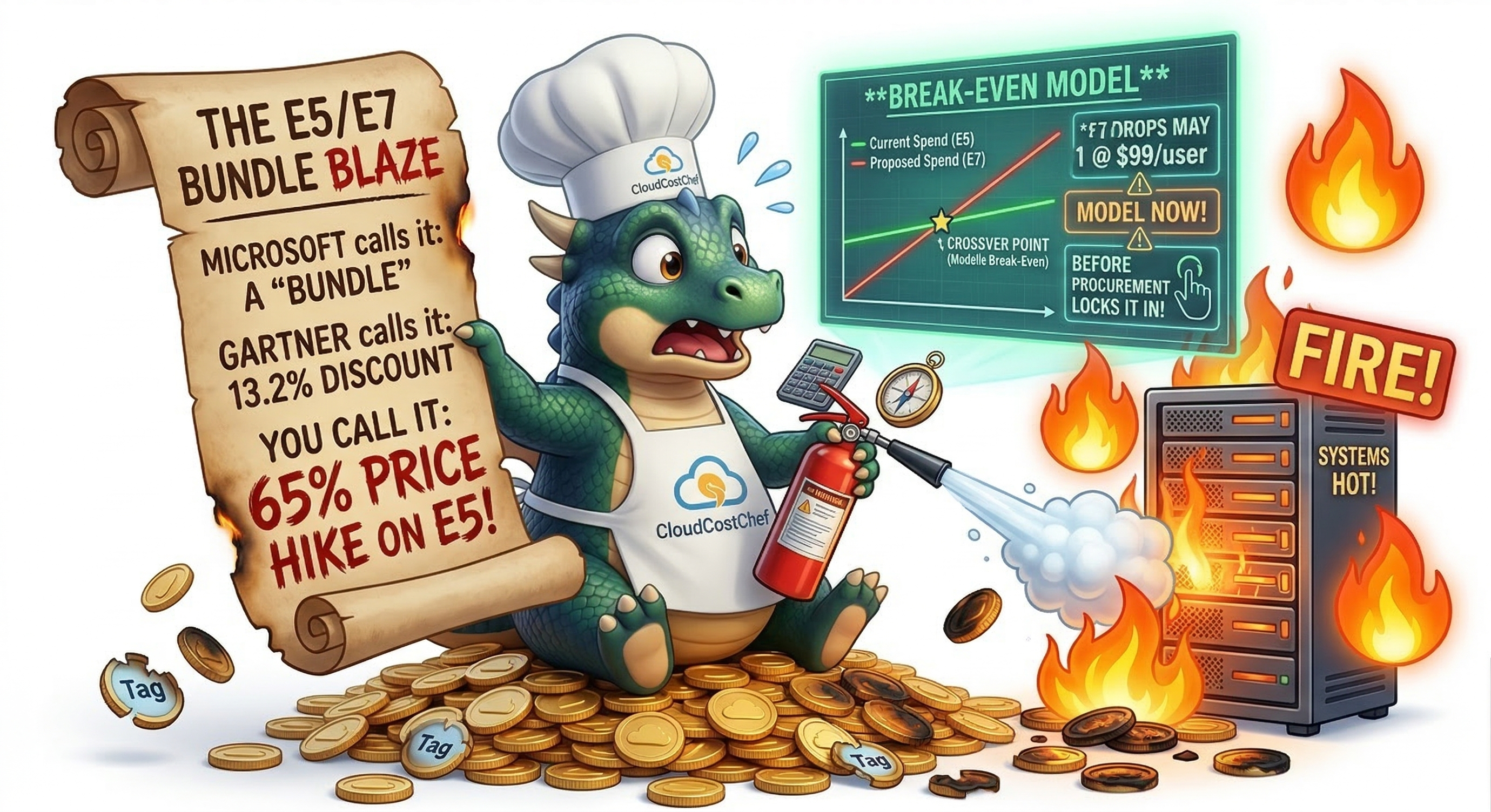

The FinOps question is not “Is E7 good?”
The real question is whether your organization should prepay for broader AI capability before it has proved adoption, usage intensity, and renewal economics for the users who would get it.
What Microsoft Officially Announced on March 9
Microsoft's March 9, 2026 announcement introduced Microsoft 365 E7: The Frontier Suite, positioned as a bundled offer that combines Microsoft 365 E5, Microsoft 365 Copilot, Agent 365, Entra Suite, and related security/governance capabilities. Microsoft says both E7 and Agent 365 become generally available on May 1, 2026.
Announced
March 9
Microsoft blog + security launch
E7 list price
$99
Per user, per month
Agent 365 list price
$15
Per user, per month standalone
General availability
May 1
Six-week evaluation window
Microsoft also says E7 is priced below buying equivalent capabilities separately. That is directionally true at list price. It is not the same as saying it is the right renewal move for your tenant.
The Math Microsoft Would Prefer You Skip
The market conversation around E7 is getting compressed into one line: “it's a bundle discount.” That simplification hides the two variables that matter most in real renewals: timing and actual usage.
| Scenario | Current list baseline | E7 list price | Monthly delta |
|---|---|---|---|
| Renew before July 1, currently on E5 only Largest jump. You are adding Copilot and Agent 365 before the baseline price hike lands. | $57 | $99 | +$42 |
| Renew on or after July 1, currently on E5 only The step-up shrinks slightly only because E5 got more expensive. | $60 | $99 | +$39 |
| Renew before July 1, already on E5 + Copilot Closer call if Agent 365 and bundled governance/security features are genuinely needed. | $87 | $99 | +$12 |
| Renew on or after July 1, already on E5 + Copilot Often the most defensible pilot cohort, assuming active Copilot usage is already proven. | $90 | $99 | +$9 |
Important modeling note
These are list-price reference scenarios, not your final commercial outcome. Real renewals depend on existing EA discounts, whether you already buy Entra Suite or adjacent security add-ons, and whether Microsoft is using E7 to reset your current discount position. That is exactly why FinOps needs to be in the room.
Secondary coverage from TechTarget summarizing Gartner's view puts the bundle discount at roughly 13.2% versus list-price components, which is real but not extraordinary. The more important issue is that the bundle math can look better after July 1, 2026 simply because Microsoft 365 E5 rises to $60 per user per month.
Adoption Reality: Copilot Seats Are Growing, but Penetration Is Still Low
Microsoft said in its FY26 Q2 earnings call that it now has 15 million paid Microsoft 365 Copilot seats, up more than 160% year over year. That is strong growth. It is not universal adoption.
Separate Microsoft 365 reporting cited by independent licensing analysts puts the commercial seat base at more than 450 million paid seats. That means Copilot paid penetration is still roughly 3.3% of the installed base. The high-level implication is straightforward: most organizations are still early in proven Copilot adoption, even if Microsoft's growth narrative is strong.
Paid Copilot seats
15M
Microsoft FY26 Q2 earnings call
Commercial paid seat base
450M+
Microsoft 365 reported base
Implied penetration
~3.3%
Still single-digit adoption
This is why E7 is a FinOps problem, not just a procurement problem. If active Copilot usage across your licensed seats is still weak, bundling more AI cost into the same renewal is a value-risk decision, not a convenience upgrade.
Agent 365 Is the New Variable, and Even Microsoft Says Some Parts Remain in Preview
Microsoft positions Agent 365 as the control plane for AI agents: visibility, lifecycle management, guardrails, risk signals, access control, DLP, audit, and response. That governance layer is the strategic reason E7 exists.
But the launch materials also say several Agent 365 capabilities will still be in public preview on May 1. That matters because procurement tends to evaluate bundles as if every included capability is fully mature on day one. The product direction may be sound. The operational readiness for your specific deployment may still lag the contract date.
Contract nuance that deserves legal review
Analyst coverage of Gartner's guidance warns customers to avoid nonreduction clauses that would prevent stepping back down if Microsoft changes the offer or value fails to materialize. That should be flagged before signatures, not after rollout disappointment.
Who E7 Might Actually Fit
Best early-fit cohort
Users already on E5 plus Copilot, with demonstrable active usage, plus a real requirement for agent governance, identity controls, and compliance oversight.
Higher-risk cohort
Organizations not yet proving Copilot value, or those considering a broad E7 rollout mainly because bundle messaging feels easier than user segmentation.
That distinction matters. If you already buy E5 and Copilot broadly, E7 can be an incremental decision about governance and packaging. If you do not, E7 is a larger commitment to AI monetization before the business case is mature.
What to Do Before May 1
1. Pull actual 30-day Copilot activity by licensed seat
Do not use assigned seats as adoption. Measure how many licensed users were active in the last 30 days and how often they were active.
2. Model three scenarios using your real renewal date
Compare E7 against staying on E5 with selective Copilot and against your current stack after the July 1 pricing change. Date precision changes the answer.
3. Segment users instead of assuming everybody needs the same AI tier
Finance, sales, legal, engineering, and frontline operations rarely have the same Copilot intensity or the same need for agent governance.
4. Escalate contract guardrails now
Have legal and procurement review nonreduction language, downgrade flexibility, true-up mechanics, and whether discounts reset under the new bundle structure.
CloudCostChefs Playbook for This Decision
E7 is a Microsoft licensing event, but the operating discipline is classic FinOps: allocate cost correctly, enforce governance, monitor ongoing usage, and refuse to confuse assigned budget with realized value.
Measure usage before budget expansion
Use our Copilot optimization guidance as the instrumentation layer before you broaden licensing scope.
Azure Copilot Cost OptimizationBuild showback that procurement can actually use
Treat AI bundle cost like any other shared service and force allocation logic before rollout.
Cost Allocation Best PracticesUse governance, not optimism
This is where policies, approvals, ownership, and review cycles matter more than launch-day excitement.
Cloud Governance Best PracticesKeep optimization continuous after renewal
E7 does not end the work. It starts a longer usage-verification loop that should keep dead seats and weak cohorts visible.
Continuous Optimization Best PracticesBottom line
E7 is not obviously bad. It is not obviously cheap either. It is a renewal-timing, utilization, and contract-structure decision wrapped in AI marketing. The teams that avoid kitchen fires are the ones that model before Microsoft bundles.
FAQ
Is Microsoft 365 E7 automatically cheaper than buying capabilities separately?
Not automatically. Microsoft positions E7 as cheaper than buying equivalent capabilities a la carte at list price, but the real answer depends on your renewal date, current E5 discounting, whether you already buy Copilot, and whether you actually need Agent 365 or Entra Suite for the same users.
Why does the July 1, 2026 E5 price increase matter so much?
Because it changes the baseline in the middle of many renewal cycles. If you renew before July 1, Microsoft 365 E5 list pricing is lower than it will be afterward, so the incremental step-up to E7 is larger. If you renew after July 1, the gap narrows, but only because the baseline got more expensive.
Should organizations roll E7 out broadly on May 1, 2026?
Most organizations should model it first rather than defaulting to a broad rollout. The cleanest early candidates are users already on E5 plus Copilot who also need agent governance and adjacent security controls. For everyone else, prove Copilot utilization and business value before locking in a larger bundle.
What single metric should FinOps teams ask for before approving E7?
Ask for active Copilot usage by licensed seat over the last 30 days. If adoption is weak, bundling more AI into the same renewal usually moves cost faster than value.
Sources & Accuracy Notes
Reviewed on March 18, 2026. This article uses Microsoft primary sources for announcement timing, list pricing, and launch-state capability notes. Analyst discount critique and contract-risk guidance are attributed to secondary coverage and should be read as advisory interpretation, not Microsoft policy language.
- Microsoft Security Blog: Secure agentic AI for your Frontier TransformationMicrosoft • Accessed Mar 18, 2026
Primary source for the March 9, 2026 Microsoft 365 E7 and Agent 365 announcement, included capabilities, and May 1 general availability timing.
- Microsoft Agent 365 product pageMicrosoft • Accessed Mar 18, 2026
Primary source for Agent 365 positioning as the control plane for agents and product capability framing.
- Microsoft Community Hub: Agent 365 will be generally available on May 1, 2026Microsoft Tech Community • Accessed Mar 18, 2026
Used for the standalone Agent 365 list price of $15 per user per month and May 1, 2026 availability date.
- Microsoft FY26 Q2 earnings release / call materialsMicrosoft • Accessed Mar 18, 2026
Used alongside earnings call reporting for current Microsoft 365 Copilot seat-count context in early 2026.
- Directions on Microsoft: M365 E7 to Launch May 1 for $99 Per User Per MonthDirections on Microsoft • Accessed Mar 18, 2026
Used for secondary confirmation of E7 bundle composition, $99 list price, and bundled Entra Suite/security-governance context.
- TechTarget: Microsoft 365 E7 bundle analysis citing GartnerTechTarget • Accessed Mar 18, 2026
Used for the roughly 13.2% list-price discount framing and Gartner-attributed caution around maturity and negotiation posture.
- Office 365 for IT Pros: Microsoft increases Office 365 and Microsoft 365 license pricesOffice 365 for IT Pros • Accessed Mar 18, 2026
Used for the July 1, 2026 Microsoft 365 E5 list-price increase to $60 per user per month and commercial licensing context.
- The Motley Fool summary of Microsoft FY26 Q2 callThe Motley Fool • Accessed Mar 18, 2026
Used as a secondary source for Microsoft's disclosed 15 million paid Copilot seats and year-over-year growth language from the earnings call.
- Azure Copilot Cost OptimizationCloudCostChefs • Accessed Mar 18, 2026
Referenced as the internal usage and instrumentation playbook before broadening AI license commitments.
- Cost Allocation Best PracticesCloudCostChefs • Accessed Mar 18, 2026
Referenced for showback and cost-allocation discipline during SaaS and AI renewal modeling.
- Cloud Governance Best PracticesCloudCostChefs • Accessed Mar 18, 2026
Referenced for approval controls, governance workflow, and ownership guardrails.
- Continuous Optimization Best PracticesCloudCostChefs • Accessed Mar 18, 2026
Referenced for post-renewal usage verification and ongoing optimization discipline.