The 5 Stages of FinOps Grief (and the Stage 6 Teams Actually Need)
Every cloud team goes through the first five stages. Most teams get trapped at dashboard theater. The teams that reduce waste in 2026 move to Stage 6: engineering hygiene.
Freshness & Review
Review due soon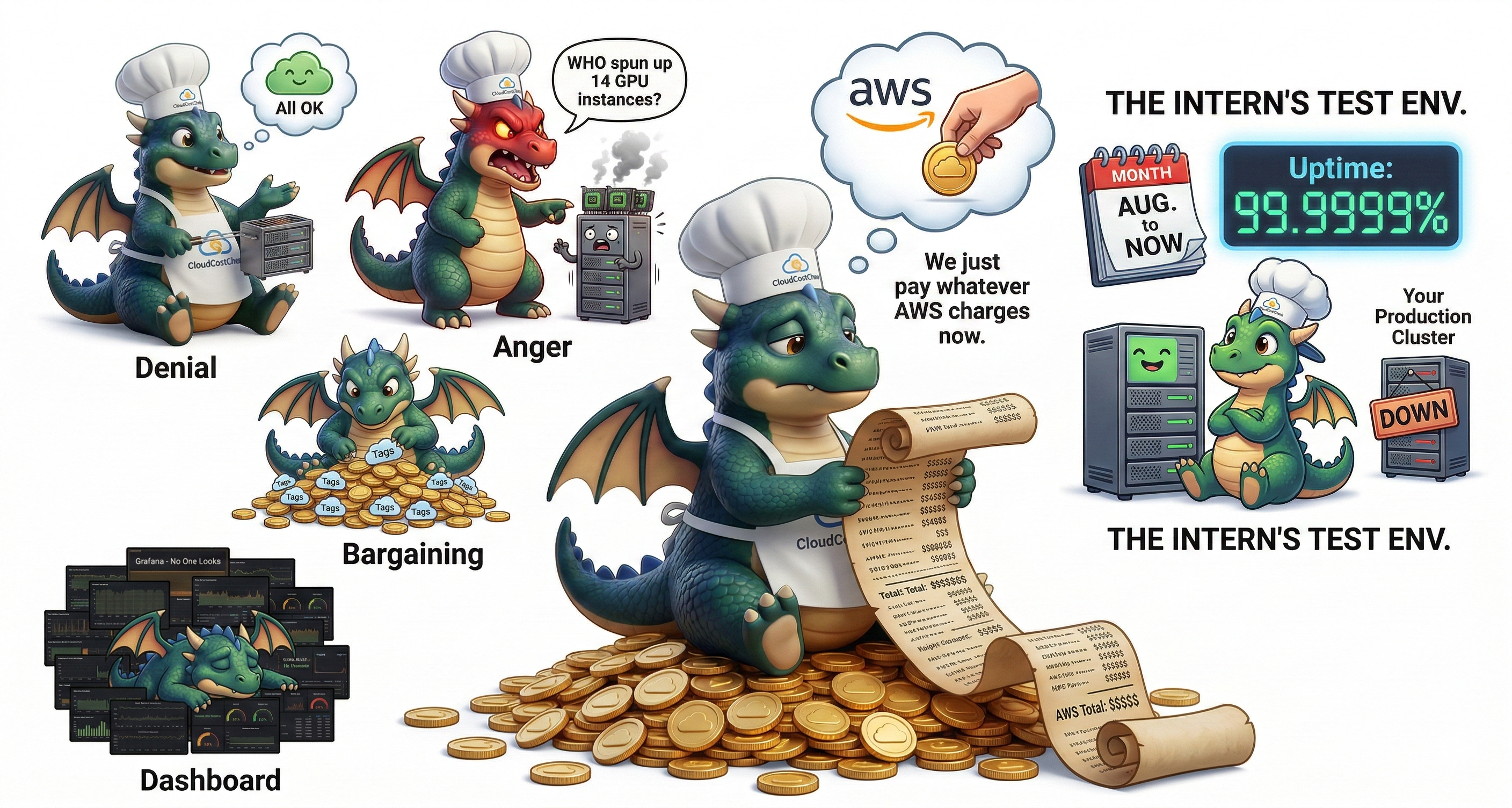

Why This Framework Works
The five stages map to real behavior patterns in FinOps execution: denial of waste, reactive panic, unrealistic cleanup promises, dashboard-heavy theater, and eventual resignation. The point is not humor. The point is diagnosis.
The 5 Stages of FinOps Grief
Stage 1
Denial
"Our cloud bill is fine." It is not fine. It has not been fine since someone launched a temporary environment months ago and nobody owns it.
Stage 2
Anger
"Who launched 14 GPU instances in us-east-1?" The answer is usually an ex-employee account, stale credential, or missing ownership guardrail.
Stage 3
Bargaining
"If we tag everything by Friday, we can fix this." Most teams tag part of the estate and stall. Detection and cleanup are slower than optimism.
Stage 4
Dashboard
Dashboards multiply. Alerts multiply. Attendance does not. This is where many teams mistake observability for operational change.
Stage 5
Acceptance
"We just pay whatever AWS charges now." That mindset turns small recurring misses into structural waste.
The plot twist
Meanwhile, the intern's test environment has been running since August and has better uptime than production. It is tagged correctly because the intern actually followed onboarding docs.
What the Data Actually Says
As of March 2026, the newest large public benchmarks come from the 2025 vendor survey cycle and the FinOps Foundation 2026 dataset. They are directional, but they all tell the same story: action latency is high and execution still lags visibility.
Detection and remediation lag
The 2025 State of FinOps report cycle cites an average of 31 days to identify idle resources and another 25 days to rightsize. That means waste can sit for nearly two months before meaningful action.
Basic optimization controls are still missing
The same report cycle indicates 71% of teams are not using spot orchestration, 61% are not rightsizing, and 58% are not using savings plans consistently. These are foundational controls, not advanced FinOps tactics.
Execution gap remains visible in 2025
CloudBolt's May 2025 FinOps Execution Gap research reports that 78% of leaders struggle to demonstrate cloud ROI, and 58% say detection/remediation still takes weeks or months despite high claims of automation. That is the modern version of Stage 4.
Waste remains structurally large
Harness projected $44.5B in cloud waste by the end of 2025. Whether the exact 2026 number is higher or lower, the pattern is unchanged: waste is usually death by a thousand small misses, not one catastrophic architecture choice.
FinOps scope got bigger again in 2026
The FinOps Foundation's 2026 dataset (1,192 respondents) shows teams are now managing far more than cloud alone: 98% report managing AI spend, 90% SaaS, 64% licensing, 57% private cloud, and 48% data center. Stage 6 hygiene is the only way lean teams keep up.
The Real Stage 6: Engineering Hygiene
Stage 6 is where teams stop treating cost as a reporting function and start treating it as a system reliability discipline: ownership, automation, and hygiene.
1. Tag at creation, not retroactively
Manual cleanup drives Stage 3 bargaining loops. Auto-tagging breaks that cycle.
2. Enforce mandatory tag policy
Policies make ownership non-optional. “We forgot” stops being a valid answer.
3. Schedule non-prod shutdowns
Nights and weekends should not look like business hours for dev/test estates.
4. Run recurring orphan-resource sweeps
Forgotten disks, IPs, and stale app resources are classic Stage 1/2 triggers.
A 30-Day Stage 6 Rollout
| Week | Priority | Output |
|---|---|---|
| Week 1 | Tagging and ownership baseline | Mandatory tags + owner map for top spend services |
| Week 2 | Idle resource hygiene | Top 20 idle spend candidates with action owner/date |
| Week 3 | Automation and scheduling | Auto-shutdown schedule + weekly detective report |
| Week 4 | Governance and recurring rituals | Monthly operating cadence with action closure KPI |
Bottom line
Stage 6 is not a new dashboard. It is policy + ownership + automation. Tag it. Own it. Clean it. Repeat.
FAQ
What is the biggest reason teams get stuck in FinOps Stage 4?
Teams over-invest in dashboards and under-invest in ownership, automation, and enforcement. Visibility helps, but cost outcomes improve only when teams attach actions, deadlines, and accountability to findings.
Are the 31-day detection and 25-day remediation numbers current?
They are from the latest published Harness FinOps survey cycle as of March 2026 (released February 2025, fielded late 2024). Use them as directional benchmarks and validate your own lead times in production.
How do we move from Stage 5 to Stage 6 quickly?
Start with engineering hygiene: enforce required tags, auto-tag at creation time, schedule non-production shutdowns, and run recurring orphan-resource audits. These four controls produce consistent savings faster than adding more dashboards.
CloudCostChefs toolbox for Stage 6
If your team is currently stuck in Stage 4, start with one automation and one enforcement policy this sprint. Do not wait for a perfect framework.
Sources & Accuracy Notes
Reviewed on March 4, 2026. This article prioritizes the newest available public datasets (FinOps Foundation 2026 plus 2025 survey cycles from Harness and CloudBolt). Vendor-backed figures are directional operational benchmarks, not universal constants.
- Harness FinOps in Focus 2025 (press release summary)PR Newswire / Harness • Accessed Mar 4, 2026
Used for 31-day average detection time, 25-day average remediation lag, and adoption gaps (71% spot orchestration, 61% rightsizing, 58% savings plans) plus $44.5B projected waste figure.
- Harness blog: 2025 State of FinOps summaryHarness • Accessed Mar 4, 2026
Used as supporting source for optimization friction and operational lag context from the same report cycle.
- CloudBolt FinOps Execution Gap study (May 2025 press release)CloudBolt • Accessed Mar 4, 2026
Used for newer 2025 execution-gap benchmarks: 78% struggle to demonstrate cloud ROI and 58% report detection/remediation still takes weeks or months (350 U.S. senior IT leaders surveyed).
- CloudBolt 2025 Industry Insights report summaryCloudBolt • Accessed Mar 4, 2026
Used for 2025 operational execution signals including policy/governance enforcement gaps and recommendation implementation friction.
- FinOps Foundation: State of FinOps data portalFinOps Foundation • Accessed Mar 4, 2026
Used for 2026 scope expansion context (AI, SaaS, licensing, private cloud, and data center responsibilities) and team-size benchmarks.
- FinOps Foundation Mission Update (February 2026)FinOps Foundation • Accessed Mar 4, 2026
Used for recency context on community scale and 2026 operating focus updates.
- CloudCostChefs Tool: Azure Auto-Tagging FunctionCloudCostChefs • Accessed Mar 4, 2026
Referenced in Stage 6 runbook for ownership and tagging hygiene automation.
- CloudCostChefs Tool: Mise-en-Tag Enforcer for AWSCloudCostChefs • Accessed Mar 4, 2026
Referenced in Stage 6 runbook for mandatory tag policy enforcement.
- CloudCostChefs Tool: Mise-en-Tag Enforcer for AzureCloudCostChefs • Accessed Mar 4, 2026
Referenced in Stage 6 runbook for mandatory tag policy enforcement.
- CloudCostChefs Tool: Mise-en-Place Multi-Cloud VM SchedulerCloudCostChefs • Accessed Mar 4, 2026
Referenced for idle environment scheduling and automated start/stop discipline.
- CloudCostChefs Tool: Azure Forgotten Resource DetectiveCloudCostChefs • Accessed Mar 4, 2026
Referenced for orphaned/forgotten resource identification in Stage 6 cleanup.
- CloudCostChefs Tool: Shadow Waste AssessmentCloudCostChefs • Accessed Mar 4, 2026
Referenced for structured multi-cloud waste triage and implementation planning.